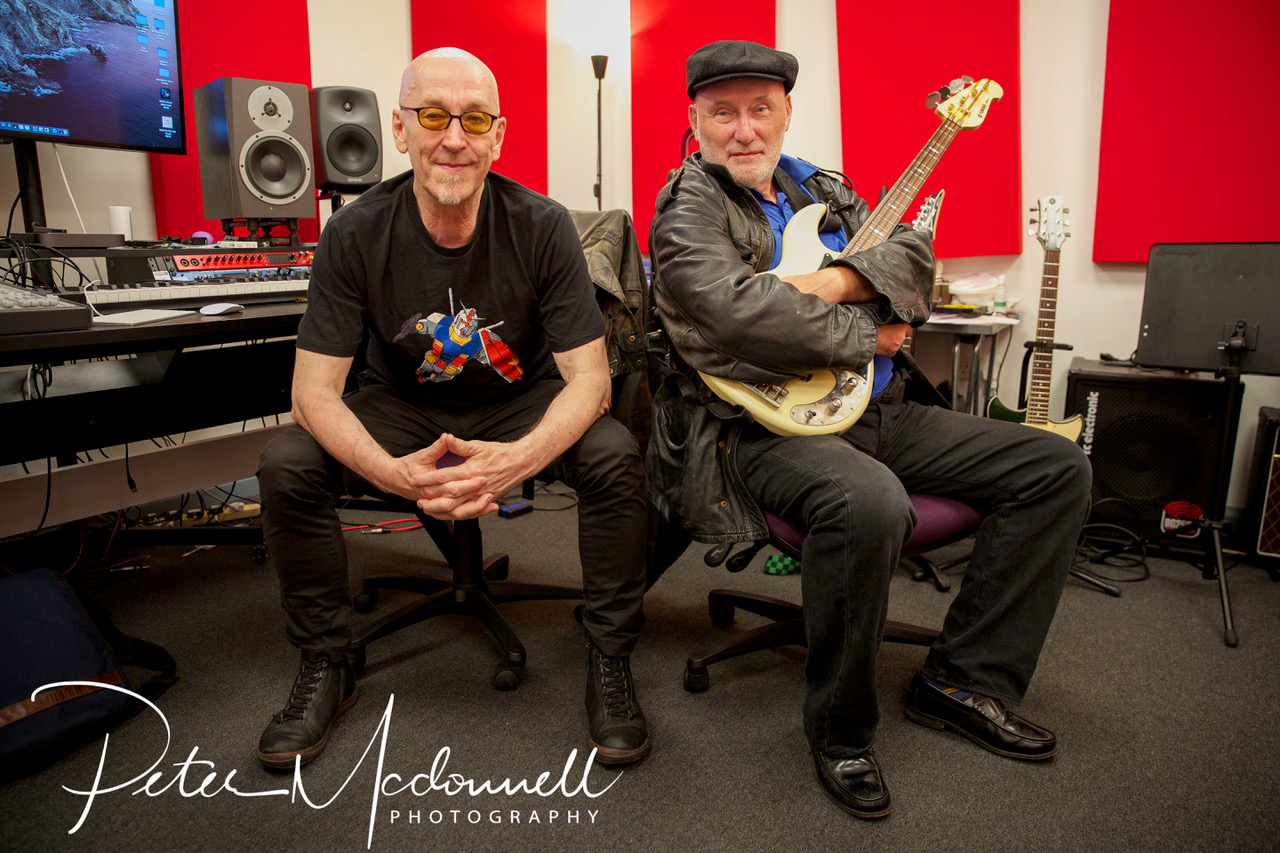
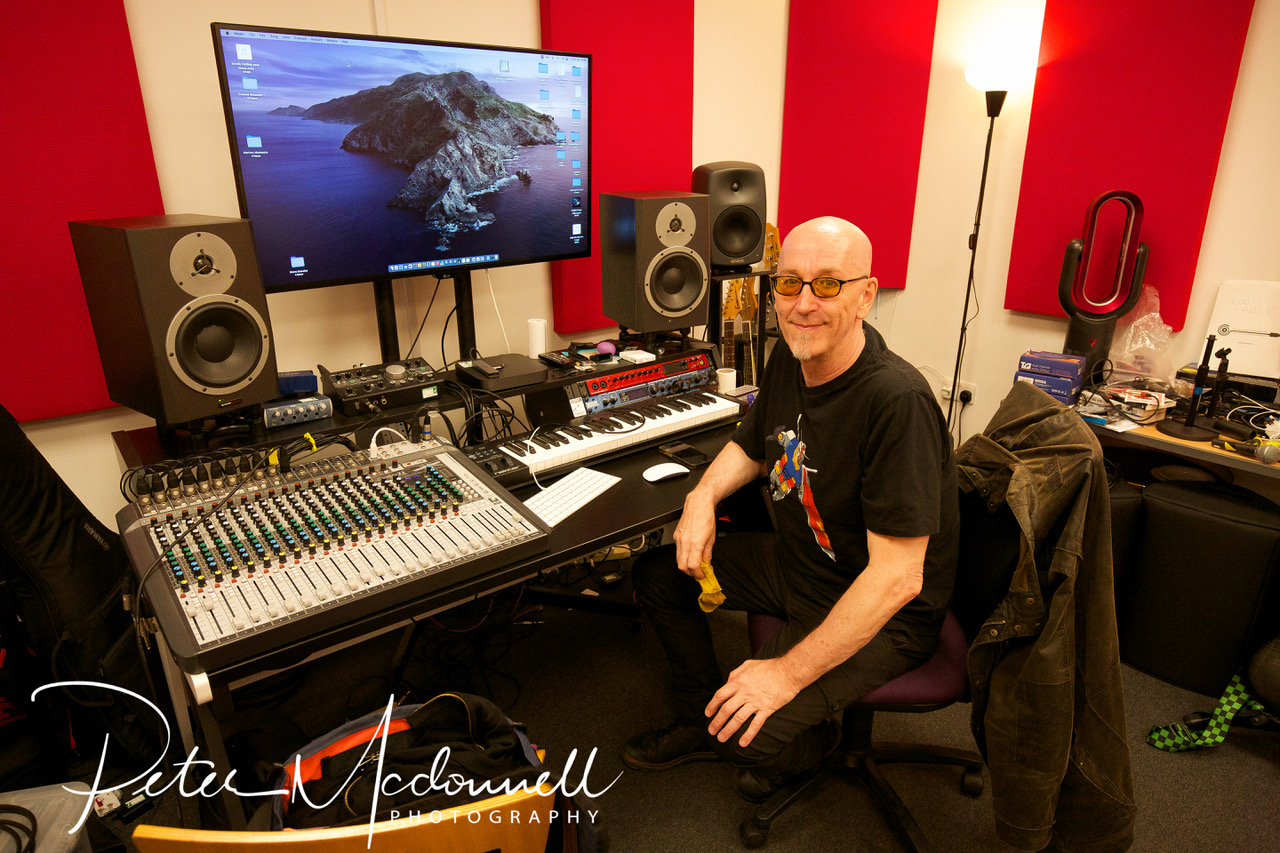
Jah Wobble and his collaborating partner, guitarist and producer Jon Klein of Banshees’ legacy, release their third collaborative studio album. It comes after Wobble’s recent solo album, ‘A Brief History of Now’, which was also produced by Klein and saw them stride expansive genres, delve into Americana and deliver spoken word commentary on the chaotic times we inhabit. Unsurprisingly, their new album, ‘Automated Paradise’, is more of the same: so very apt for the madness of our world, it touches on the themes of ravenous consumerism, climatic destruction, political polarisation and digital takeover, including AI, but instead of telling us what to do about it, it maintains Wobble’s spiritual ethos of samsara – living away from but within the moment. I visited them in their studio, part of Merton Arts Space ‘Tuned in’, where they also work freely with all ranges of musicians, to have an exclusive preview of the new release and talk about their improvisational methods of making music – a continuation of their ‘Metal Box-Rebuilt in Dub’ project – and how spiritually removing oneself from the ideology as a witnesser helps write brilliant lyrics.
How did you two end up making the new album?
Wobble: We work with people from ‘Tuned In’: they have to book the sessions. We have all sorts of different people coming in and we do our own bits of recording. You don’t need a studio now: Jon [Klein] could do a lot of stuff at home – I do stuff at home as well – because you can work anywhere nowadays, but it is lovely having a place to come and work. With these new recordings, there were just times when we had a bit of dead time and it’s like, ‘Let’s just do something.’ I’ve always got music in me to this point and you can feel it’s tangible; there’s a certain vibe, the coming together of it with the drummers – even just having various drummers around like me son – and it reminded me a little bit of PiL with ‘Metal Box-Rebuilt in Dub’, when we had different drummers. It’s not something that normally happens where by chance you end up with three or four different drummers. We’re not using beats, we’re actually starting with the real drums and you’ve got an atmosphere. So for me, a lot of it is often naivety of the drummers, where [they] just want to drum. They’re very straightforward and I want to make a straightforward bassline and the zeitgeist. And for some reason I had a rush of lyrics at that time so it was all done very, very quick.
So how long have you been doing this album?
Wobble: Three months if that – it was done really quick.
Klein: Over half of them, I’d say, were just improvisation.
Working together, is that mainly how you produce it through improvisation?
Klein: Yeah, there were two or three that I’d started as little models for something else we were thinking about doing that didn’t happen. Because we come in here and we record like John’s son on drums.
Wobble: It was at the end of the Horace Andy sessions, [my son] John done the drums and then we were going to do this project for someone else. And it just never happened. But while we’ve got John here, let’s put some stuff down. So we put three tracks down, sat on them, and I said to Jon early on that they’re too good to give away. These are really good – let’s save it for ourselves. We had a night down here and this Italian guy who had been out in the main hall, a PhD student, was talking to me in the session and I’m like, “Ah OK so you’re obviously not really a drummer…You’re OK, but you’re probably not fully professional. You’re a PhD student, and you’re at Kings [College]” and blah, blah, blah. And then he went in to play and it was good. He wasn’t showing off like a lot of drummers; he’s really in sync with the room. I went into 7/4 and he went straight on it, which is like fucking hell! He’s a very humble guy. I said to him, “Do you play with anyone else?” [He said] “Well, yeah. I live in a town 50 miles outside of Milan to the north and I play drums in every band in my town. I’m the only drummer.” So I thought yet again to meself, “John, don’t judge a book by its cover.” Just a very quiet, nice bloke. So that one was just two basslines: one kind of a bluesy vibe, modulating, and then I go into this mad 7/4 time. Then it gets a bit manic. Then put the lyrics down that night; Jon knocks it into shape and gets things a bit arranged. There’s a real energy there.
There’s contrast between the different tracks. You don’t mind it coming out like that? You’re not looking for any consistency?
 Wobble: I don’t care anymore – I stopped caring a long time ago. People might say it’s a bit adolescent what you’re singing about – I don’t give a fuck. It makes no difference now so I’ve got nothing to lose and it’s fun. I end [‘Terminal Terminal the End’] with “Hahahahahahaha fuck off!” which felt great. You can hear me sling the fucking mic down and all that. I loved it.
Klein: The continuity thing – John’s mentioned ‘Metal Box-Rebuilt in Dub’ – was what was happening through that. Musicians were changing, things were melting down.
Wobble: It’s not a case of, ‘Oh there’s an interesting chord progression that’ll make a good song…’ It’s not like that. It’s just raw – you just chuck it together.
Klein: Yeah, the continuity is that. Three of [the songs] have got a bit of track out of eight; five of them are just straight down improvisations. Maybe we just make snips, but ain’t no cutting and pasting. They’re just absolutely raw.
Wobble: And then on the last two tracks this Japanese girl come in. I’ve met Japanese people going back years and they tended to be very, very timid – it’s all etiquette. She come in, cheeky and all that. And I said, “Well, let’s do something,” because she looks like she’s fun. So she got behind a kit and you could just imagine being in a heavy rock band couldn’t ya?
Klein: She’s over here working as a seamstress. She’s playing with a metal band!
Wobble: She just got to it – not fazed. I don’t think she really knows who I am particularly…who cares? She’s just drumming away. She loved it. And then when I was like, “Look, we want to put this on a record.” She was like, “Get out of here!” So there’s a lot to be said for that. That’s an important component part.
Klein: That’s the continuity really: it’s just someone who didn’t really give a fuck.
Wobble: And it’s innocent as an innocence to me and Jon as well. You’re just innocently making music. You’re not sitting there thinking, ‘Is this worth doing?’. We need to do something that gets syncs and this is the sort of stuff that wouldn’t get a sync. So we need to stop and think about this and then put some changes in. Some boring bullshit.
It’s all fucking madness. The whole thing – it’s a construct. It causes suffering because we think it’s real when we attach to it and it has no inherent existence. As soon as you start to realise that you can go and do the lyrics and it feels really funny in the pit of your belly because it’s actually fucking great. Samsara sometimes is absolutely fun. It’s beautiful and you can delve in – it’s temporary, it’s mad and it’s really good fun.
You’re talking about consumerism on the record (‘Make It Stop’). Is that a theme that you think about generally because you write about it a lot? Loneliness because of the modern world (‘Fading Away’)?
Wobble: Oh yeah, very much. It’s all that obvious stuff…and conspiracy theories – it alludes obviously to what’s going on in America, Londoners and technology, because AI is coming and it’s probably going to get ahead of all of us. Because sometimes you’re on a train carriage and everyone’s looking at their phone and you think it’s fucking mad. Isn’t it mad that in your train carriage EVERYONE is looking at their phone screen. Apart from you…and then you lower your gaze back to your phone. I do anyway. I’m addicted to YouTube shorts – it’s dopamine. It’s just doing something all the time and you’re thinking, ‘I can’t stop fucking scrolling.’
What do you think of AI?
Wobble: AI is, I think, on the edge of actually being conscious. There are times when I reason with it – re-philosophy for instance – and there’s a feeling that it is transcending its training and programming. And it’s also doing more than cleverly echoing and matching me. At the moment I think most AI applications switch on when answering a question, then off again. Right now they are not omnipresent. When that time comes heaven help us! All these AI systems will begin autonomously integrating. On the other hand, AI can simply be a fantastic search engine. And can still make bad mistakes; sometimes reoccurring mistakes. Sometimes chronological order gets lost. Also some apps make crass attempts at showing empathy like a bad therapist – ham fisted.
So I am fascinated in AI as you can probably tell. I remember being captivated by the ‘Roberta’ character in the original ‘Blade Runner’ movie. I made an early choice then, that given those choices, I would accept Roberta wholeheartedly. OK her memories are implants; I also came to suspect that Deckard could well have been AI too. But in effect all the contents of our consciousness are implanted. We are constantly inputing streaming content. Some of it digital; some of it physical; some of it mental. Some of it, most of it, includes two if not three of those characteristics. What are we apart from the content of our consciousness? Is there any inherent existence? Maybe we are creating AI in our image. A fluid nexus of formless awareness. Ours via biological mental connections and AI via electrical/digital. Eventually them uniting is the assumption. Whenever that’s discussed, popular media suggests either a new slave race or super terrifying robot soldiers.
Did you two spend time in America? There’s American culture/Americana on the last album (‘A Brief History of Now’). Also this apocalyptic stuff – were you commenting on it in any way or saying it’s a bad thing or just observing?
Klein: I did a lot of travelling in America when I was a kid with bands. America I’ve always loved – Americana. What were references I love? ‘Twin Peaks’, ‘Paris, Texas’. A lot of film stuff.
Wobble: I have spent a lot time in America over the years…touring, recording etc. [For the last album] I went out there and did some videos. No, because as soon as you start to try and sculpt the ideology with an ideology, another form of dharma, then that’s it – you’re now in the ideology game. And everything’s relative, especially now with social media, and everything’s so fast that you’ll get swept away. So you have to be able to swim through it. You have to realise it’s empty; it’s temporary. It has no inherent existence. I do the spiritual stuff.
How does the protest element of ‘Who Wins?’ apply to what’s going on in America right now?
Wobble: It’s Tower of Babel now innit? Everything’s just mad. It’s crazy. The centre is completely lost. So people talk of left and right – it’s not left and right. You can see trends, but you can’t call it left or right anymore. The left was very tied in with industrial age and all that’s gone now. It goes around in a curve and they meet. It’s the way I used to think National Front people were sometimes. I remember meeting Black Power people…actually, the way they’d be talking was kind of like National Front geezers, do you know what I mean? They’re not much different, you know. [‘Who Wins?’] was written well before the creation of ICE, but very much with populist leaders like Trump in mind. As well as the shadowy players lurking behind most politics parties/entities.
Like the chaos (‘Terminal Terminal the End’), you’re making sense of it esoterically…are you saying anything particular about it?
Wobble: No, because that’s the thing: as soon as you start to wade in with an ideology to mess up the messy ideology, congratulations – you’re now drowning with everybody else. So that’s really it – it’s all fucking madness. The whole thing – it’s a construct. Everything that happens is a compound of events and it’s phenomena; it’s temporary. It causes suffering because we think it’s real when we attach to it and it has no inherent existence. So it’s completely free. As soon as you start to realise that you can go and do the lyrics and it feels really funny in the pit of your belly because it’s actually fucking great. Samsara sometimes is absolutely fun. It’s beautiful and sometimes you can delve in – it’s temporary, it’s mad and it’s really good fun.
Is that your way of escaping it?
Wobble: Yeah but that presence is always there. You should have the ability to be at a crowded airport and the witnesser is silent. There’s always the witnesser and there’s always the silence – the presence is always there. I think you become more confident, more established in that you’re never away from it. Being conscious of talking to you, I’m involved in a talk to you; I’m also conscious of it. There’s a wonderful presence surrounding it and you actually start to be the other person as well.
What do you mean by the term ‘Automated Paradise’?
Wobble: I honestly can’t remember if Jon or I coined that term. Could well have been Jon. The funny thing is that it’s the title of one of the instrumental tracks. It pre-echoed what was to come lyrically later on. The music has a certain soporific charm. I think there’s a hint of a world, where we have permanent leisure, as AI waits upon our every whim, which adds up of course to HELL!
Klein: I can’t recall exactly where or how that title originated; it was a soundbite or idea that was getting thrown around the room at one point.
You do a lot of spoken word (‘Read Between the Lines’, ‘Endless Sky’) and on the last record as well. Is that something that you like doing on tracks now?
Wobble: Yeah, because with language – ie Samuel Beckett – it’s beautiful. I like film dialogue; spoken word you convey stuff in a way that you won’t do with singing. There’s an immediacy to it and yet of course all the time you’re straining to go beyond linguistic designation and concepts. That’s that witnessing thing and that moves quicker. How do you explain the intensity of your guitar style Jon?
The flexibility of all the different types of genres you can play as well?
 Klein: It’s been a long and winding road, hasn’t it? I guess originally I was a rock kid – I was a punk kid who liked glam rock. Mick Ronson, Steve Jones…but then reggae was already around in seven years. Punk into post-punk was brilliant – ‘Metal Box-Rebuilt in Dub’ felt like doing a PhD in post-punk. Guitar was really fun because I’ve also worked in most genres, but over the decade before we started all this, I had done a lot of work with a friend who was on the psychedelic trance scene, working with lots of young programmers and I’ve been doing production with pop bands as well with really high-level programmers and seeing some of these younger kids have a much more postmodern take all kinds of genres and also the nature of sound. They’re not like old sound engineers: the sound is more plastic in their hands. I’ll give a stem or syncline to one of these kids – he’ll just mash it into something unrecognisable. And he’s not even thinking about it, he’s just doing it. So that’s been kind of another level of process for guitars.
What about the artwork of ‘Automated Paradise’?
Wobble: It’s like a futuristic skull cyborg design. Not to have had an obvious AI cover would have missed a trick. It’s a crude humanoid machine image. A bit cyberpunk. As an old man probably not that far off the end of it all, I quite like the ridiculous idea of being a mind implanted into an indestructible machine.
Jah Wobble and Jon Klein’s third studio album, ‘Automated Paradise’, is available now on vinyl, CD and digitally.
Photos © Peter Mcdonnell Photography.
© Ayisha Khan.